
New Delhi metro map
You can find on this page the New Delhi metro map to print and to download in PDF. The New Delhi metro map presents the network, zones, stations and different lines of the metro of New Delhi in India.
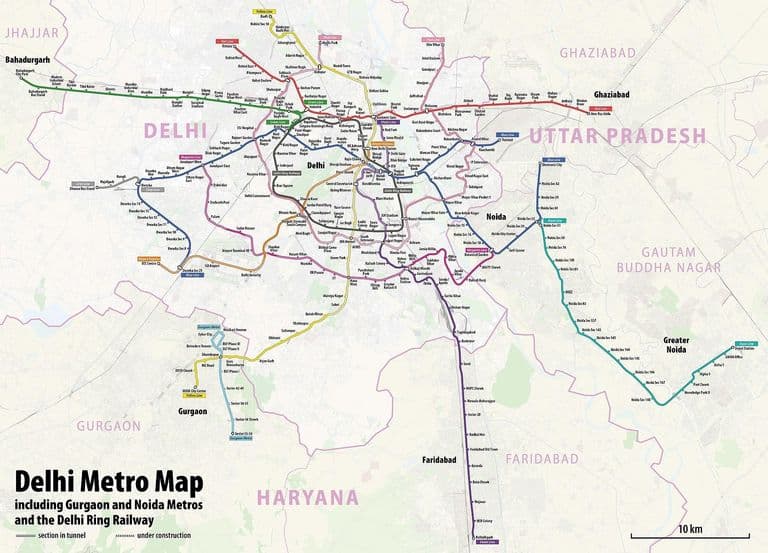
Metro map New Delhi
The New Delhi metro map shows all the stations and lines of the New Delhi metro. This metro map of New Delhi will allow you to easily plan your routes in the metro of New Delhi in India. The New Delhi metro map is downloadable in PDF, printable and free.
The Delhi Metro is a rapid transit system serving Delhi, Gurgaon, Noida and Ghaziabad in the National Capital Region of India as you can see in the Metro map New Delhi. The network consists of six lines with a total length of 189.63 kilometres (117.83 mi) with 142 stations of which 35 are underground. It has a combination of elevated, at-grade and underground lines and uses both broad gauge and standard gauge rolling stock. Four types of rolling stock are used: Mitsubishi-ROTEM Broad gauge, Bombardier MOVIA, Mitsubishi-ROTEM Standard gauge and CAF Beasain Standard gauge. The Delhi Metro Rail Corporation has been certified by the United Nations as the first metro rail and rail-based system in the world to get “carbon credits for reducing greenhouse gas emissions” and helping in reducing pollution levels in the city by 630,000 tons (630 Gg) every year.
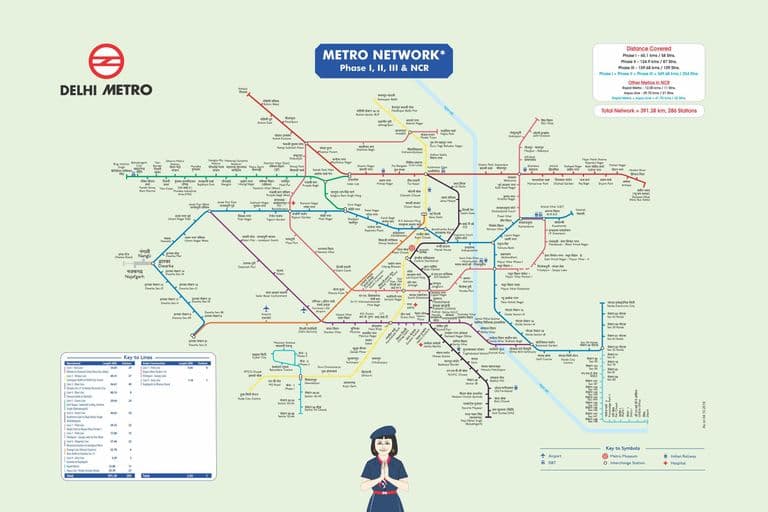
New Delhi subway map
The New Delhi subway map shows all the stations and lines of the New Delhi subway. This subway map of New Delhi will allow you to easily plan your routes in the subway of New Delhi en India. The New Delhi subway map is downloadable in PDF, printable and free.
The concept of a mass rapid transit for New Delhi first emerged from a traffic and travel characteristics study which was carried out in the city in 1969. Over the next several years, many official committees by a variety of government departments were commissioned to examine issues related to technology, route alignment and governmental jurisdiction (see New Delhi subway map). In 1984, the Delhi Development Authority and the Urban Arts Commission came up with a proposal for developing a multi-modal transport system, which would consist of constructing three underground mass rapid transit corridors as well augmenting the city existing suburban railway and road transport networks. While extensive technical studies and the raising of finance for the project were in progress, the city expanded significantly resulting in a twofold rise in population and a fivefold rise in the number of vehicles between 1981 and 1998. Consequently, traffic congestion and pollution soared, as an increasing number of commuters took to private vehicles with the existing bus system unable to bear the load.